
Project overview
The submarine cable landfall is planned in the Gulf of Follonica, with two potential locations under consideration in Piombino and Follonica. Following the participatory design process and the initial Public Consultation meetings, three additional potential landfall options have emerged in Follonica. The first involves a municipal parking area adjacent to the site initially identified by Zhero; the second concerns a nearby southern residual area; and the third relates to a further adjacent parking area. These alternatives are currently under technical assessment. The final location will be defined following the Public Consultation process, detailed engineering design activities and dedicated marine environmental studies, with a particular focus on the condition of Posidonia oceanica seagrass meadows and the minimisation of environmental impacts. The landfall will be carried out using low-impact installation techniques, including Horizontal Directional Drilling (HDD), avoiding open-trench excavation and any direct disturbance to dunes or beach areas.
The Converter Station is designed to convert direct current (DC) into alternating current (AC), enabling injection into the Italian National Transmission Grid (RTN). It will represent the only visible above-ground infrastructure of TI-Link in the area. While the final site selection has not yet been finalized, the initial options identified by Zhero—two locations in Campiglia Marittima and one in Suvereto—are now considered lower priority. This follows the identification of alternative options considered better aligned with local planning and territorial requirements, as discussed with local authorities through the participatory design process.
Following the Participatory design process and the initial Public Consultation meetings, new potential site options for the Converter Station have been identified.
- four locations proposed by the Municipality of Campiglia Marittima, specifically within the industrial area of Campo alla Croce in Venturina Terme;
- three locations within the Municipality of Piombino, specifically the industrial areas known as the “36 ettari”site, the former Enel power plant area at Tor del Sale, and the former landfill site LI-53.
These alternatives are considered consistent with local planning instruments and aligned with landscape and agricultural constraints. The options are currently under technical assessment by Zhero. Any additional proposals emerging during the Public Consultation process will also be evaluated and assessed by Zhero.
The marine electrode is a key safety and reliability component of the HVDC interconnection system, designed to operate in contingency situations such as faults or maintenance activities. It consists of a buried metallic structure to be installed offshore, approximately 7–8 km from the coast between San Vincenzo and Castagneto Carducci, at a depth of around 50 metres. The final location will be defined following the public consultation process and dedicated marine environmental studies, with the objective of minimizing potential impacts on marine and coastal ecosystems.
The Terna substation in Suvereto has been identified by Terna, the Italian transmission system operator, as the grid connection point where imported electricity from Tunisia will be injected into the Italian National Transmission Grid (RTN). From this node, the energy will be dispatched across the transmission network to major load centres and demand hubs throughout Italy.
The renewable energy generation park in the Tunisian desert will consist of photovoltaic and wind power plants, with a total installed capacity of approximately 5 GW and an estimated annual production of around 15.5 TWh of certified renewable electricity. The project will be developed in the southern desert region of Tunisia, an area identified for its exceptional solar and wind resources. The final site selection is still under assessment by the Tunisian authorities.
Per poter essere trasportata su lunghe distanze, l’energia prodotta dovrà essere trasformata da corrente alternata, in corrente continua: la tecnologia più sicura ed efficace per attraversare il Mar Mediterraneo, in quanto in grado di limitare perdite e dispersioni. A tal fine, sarà necessaria una stazione di conversione, a pochi chilometri dalla costa, dove l’energia si immetterà per continuare il suo percorso verso l’Italia. La localizzazione della stazione è in fase di studio e sarà oggetto di approfondimenti da parte delle autorità tunisine.
From the northern coast, the energy will continue its transmission along the Tunisian shoreline. From there, it will be exported across the Mediterranean Sea over a distance of approximately 600 km to Italy via submarine cables. The exact landfall study area is still under evaluation by the Tunisian authorities.
The route in Italy
In Italy, the siting of the infrastructure focuses on municipalities surrounding the Terna Suvereto substation, designated by the national transmission system operator as the grid connection point. This choice is based on the Suvereto hub’s capacity to host the interconnection, its proximity to major electricity demand centres, and the need to avoid overloading central and southern Italy’s grids, already congested due to the high concentration of renewable generation.
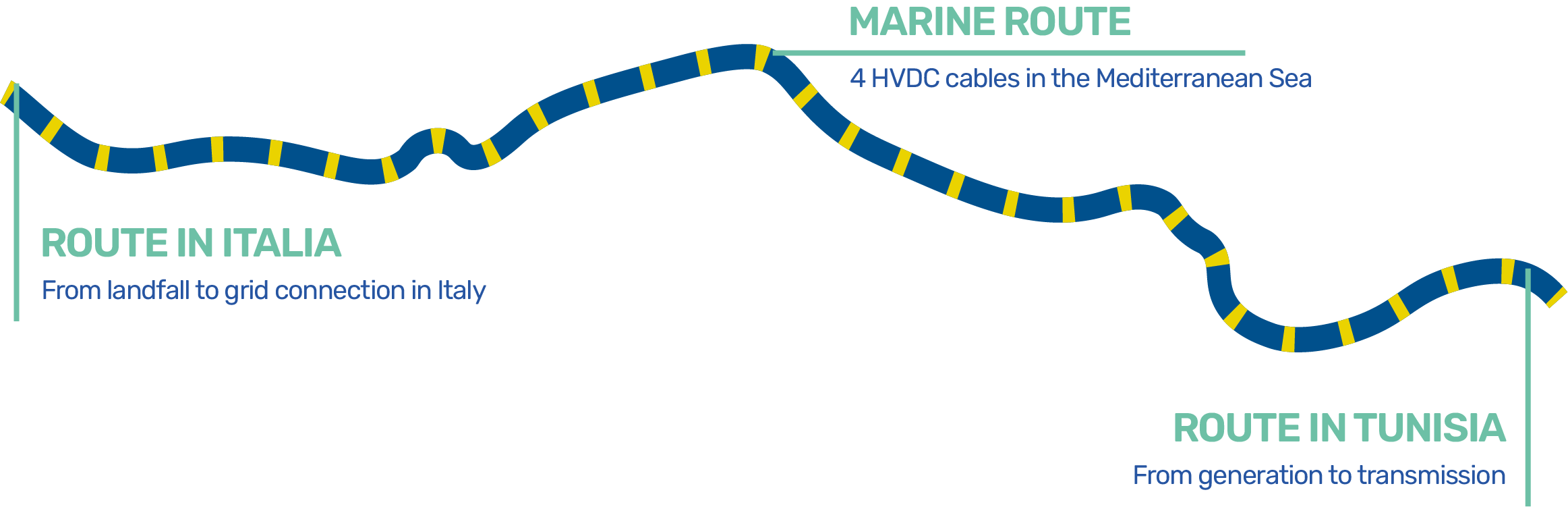
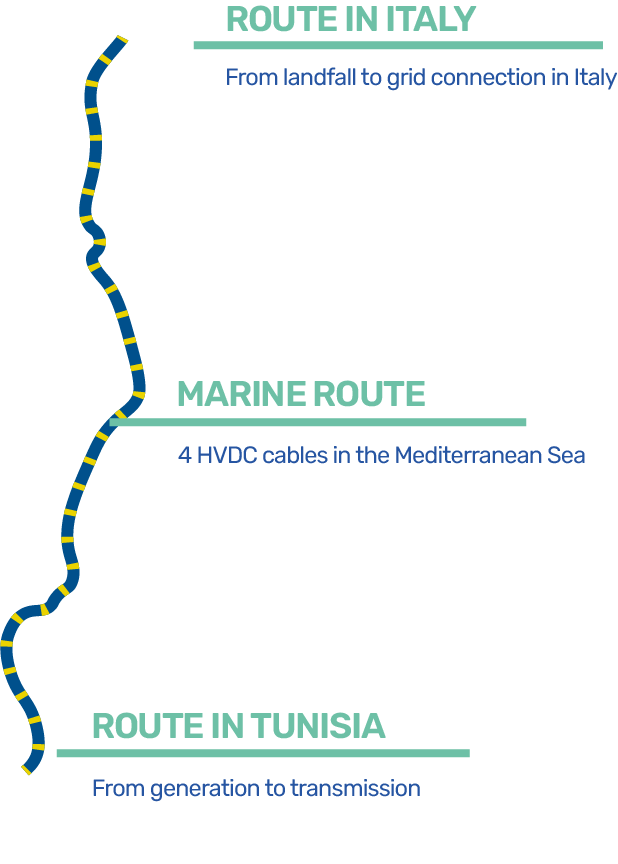
The Italian route of the infrastructure, currently under consultation with the relevant local authorities, includes a landfall point in the Gulf of Follonica area, underground cables along existing infrastructure corridors to a new converter station, and a marine electrode designed to ensure the safety and reliability of the interconnection.
Preliminary siting options for the submarine cable landfall, converter station, and electrode have undergone initial assessments that excluded the presence of significant landscape, archaeological, and hydrogeological constraints. These options have been preliminarily reviewed by the relevant national, regional, and local authorities, and subsequently updated through a Participatory Design process. They will be subject to a Public consultation, the formal citizen participation tool by current legislation as part of the permitting process before the Ministry of Environment and Energy Security (MASE).
For further information on the proposed locations, please consult the interactive map or the Non-Technical Summary.
The marine route
From the coastline to approximately 1,000 metres depth, the submarine cables will be buried beneath the seabed at varying burial depths, depending on geological and environmental conditions. This approach is designed to balance protection against potential human interference with permitted fishing activities. At depths beyond 1,000 metres, where bottom trawling and anchoring activities are minimal, the cables will be laid directly on the seabed without burial requirements.
To minimise environmental impact on the marine ecosystem, installation techniques such as jetting will be used in sandy seabeds, while mechanical trenching or rock dumping will be applied in rocky or irregular seabed conditions. At the landfall points, the connection between submarine and onshore cables will be carried out using HDD (Horizontal Directional Drilling), a trenchless technique that avoids open-cut trenching, both offshore and onshore.
The cables will be manufactured using advanced insulating materials such as mass impregnated paper or cross-linked polyethylene (XLPE), selected according to the characteristics of each section to ensure safety, reliability, and environmental compatibility. The infrastructure is designed for a minimum operational lifetime of 40 years. The interconnection may be developed in progressive phases, starting with an initial installed capacity and subsequent increases up to the planned 2 GW capacity.
The route in Tunisia
The project is designed around the development of a large-scale integrated renewable energy hub in Tunisia’s desert regions, leveraging some of the world’s highest solar irradiation and strongest wind resources.
The energy mix combines utility-scale solar PV, onshore wind generation, and Battery Energy Storage Systems (BESS), targeting an overall installed capacity of at least 5 GW. This hybrid configuration is intended to optimize resource complementarity and deliver a more balanced and reliable generation profile.
Renewable electricity generated by the plants will be transmitted to the Tunisian coast through dedicated high-voltage transmission infrastructure, developed by Zhero in close cooperation with STEG. The transmission corridor will also include intermediate connection points to support integration with the local Tunisian grid. From the coast, power will be exported across the Mediterranean through High-Voltage Direct Current (HVDC) submarine interconnectors, enabling efficient long-distance transmission while minimizing electrical losses.
The integration of large-scale BESS technology will allow the system to achieve a semi-baseload renewable generation profile — a capability that is difficult to replicate in Italy and across most of Europe. This will make it possible to supply low-carbon electricity even during traditionally hard-to-abate periods, supporting deeper decarbonization of the power sector. As with the interconnection infrastructure, the renewable generation platform can also be implemented in phases, allowing capacity to be commissioned progressively over time.
Project timeline
The timeline is indicative and subject to change based on the progress of the permitting process.